Innovation Continuum IGNITE 2026
NATO ACT’s Innovation Continuum Advanced Through IGNITE 2026 in Warsaw.
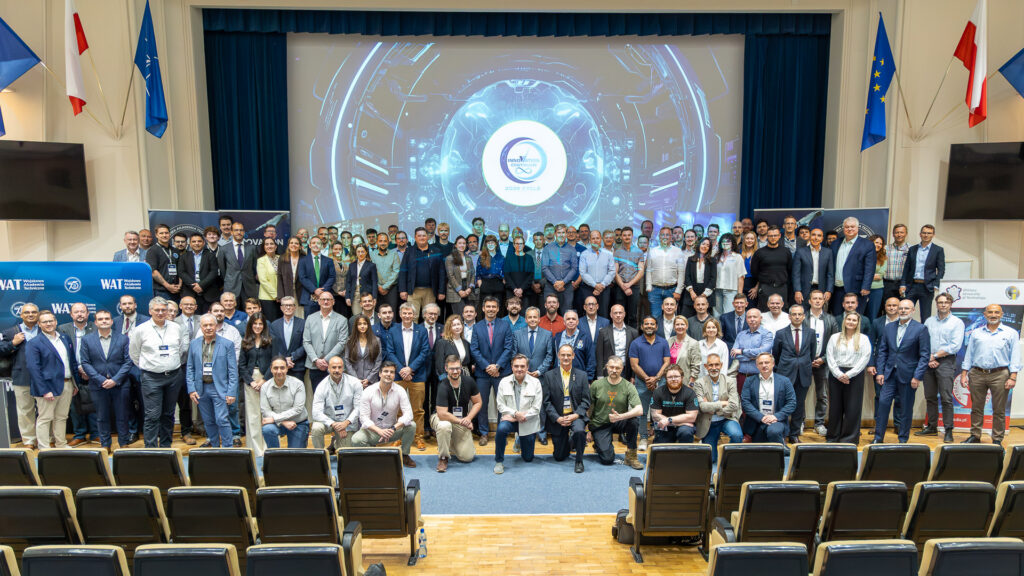
IGNITE 2026, the second major event of NATO Allied Command Transformation’s (ACT) Innovation Continuum (IC) for 2026, took place in Warsaw, from May 5th to May 7th at Poland’s Military University of Technology Wojskowa Akademia Techniczna (WAT), an increasingly active academic partners of the IC.
The participation included a total of over 200 participants, with 62 private companies and 6 academic bodies attending.
Now entering its third edition, the IC has become one of ACT’s flagship frameworks for nurturing and accelerating the adoption of emerging and disruptive technologies across the Alliance. Developed in cooperation with multiple NATO bodies, some NATO partners’s Nations (Australia, Japan, South Korea, Switzerland and Ukraine), industry, academia and startups, the initiative provides a structured pathway through which innovative concepts can evolve from early-stage ideas into operationally relevant military capabilities.
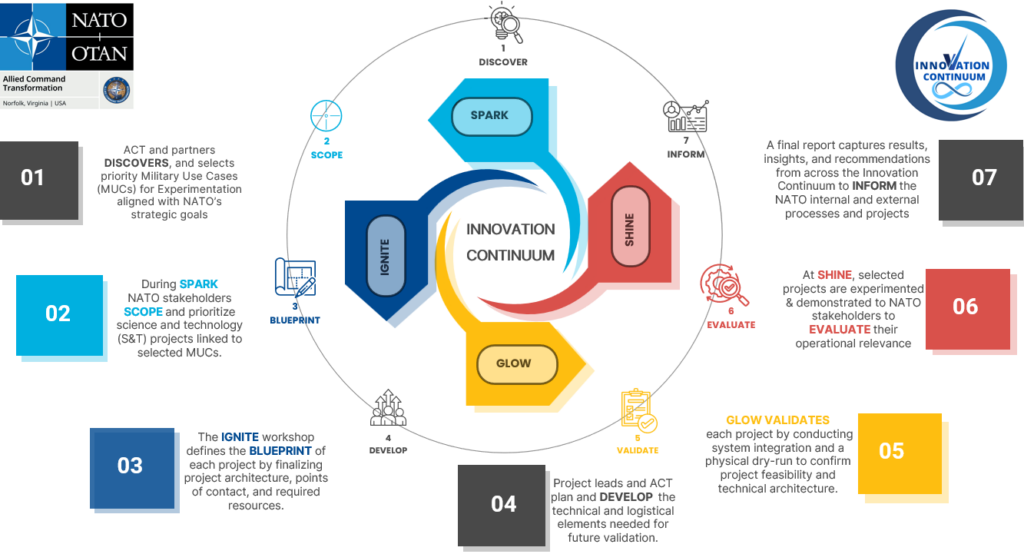
The Continuum is a year-long process organised around four interconnected phases.
- The cycle begins with SPARK, where NATO entities, industry representatives, startups and researchers identify promising technologies and define operational challenges.
- The second phase, IGNITE, transforms those initial ideas into structured operational scenarios. It is designed to refine concepts, connect stakeholders, and prepare technologies for practical experimentation. Warsaw’s hosting of IGNITE highlights Poland and WAT’s growing role in NATO innovation and experimentation efforts.
- The process then advances to GLOW, where selected technologies are integrated, stress-tested and validated in realistic operational conditions.
- Finally, the cycle culminates with SHINE, a live demonstration environment showcasing the most promising solutions developed throughout the year. The event allows NATO and participating nations to assess the operational value of innovative technologies and their potential integration into warfare development efforts.
The IC this year is placing particular emphasis on several of ACT’s priority areas, including:
- Task Force Arctic – Intelligence Surveillance and Reconnaissance for the High North
- Innovative Integration of AI into Training
- Counter-UAS Initiative
- Next Generation Targeting
- Smart Logistics and Sustainment
- Electronic Warfare
- Cognitive Warfare
- Cyber Resilience
- Integration of AI into Command, Control, Communications, Computers, Intelligence, Surveillance, and Reconnaissance (C4ISR)
Together, these themes reflect NATO’s increasing focus on integrating Quantum, AI, autonomy, resilient digital infrastructure and advanced sensing capabilities into military operations.
The Innovation Continuum: turning Emerging Technology into capabilities
At its core, the IC is designed to bridge the gap between technological innovation and operational military application. One of its defining strengths is its ability to provide medium-TRL (Technology Readiness Level) companies, research teams and startups with access to an operationally relevant experimentation platform. Rather than limiting innovation to isolated Industry R&D laboratory environments, the IC enables participants to test and refine technologies in realistic scenarios alongside military operators, government experts, academia and industry partners.
This environment offers several key advantages. Participating organisations gain direct exposure to operational requirements, opportunities to validate and improve their solutions, and access to a unique multinational network of defence stakeholders. The NATO ACT Innovation framework also provides international visibility for participating innovative companies and research institutions.
The growing relationship between NATO ACT and Poland’s WAT illustrates the value of this collaborative model. In 2023, ACT and WAT formalised their cooperation by signing a Memorandum of Understanding. The partnership subsequently brought WAT into NATO activities and experimentations and expanded its role within the IC itself.
Scientists from WAT have consistently contributed to experimentation and technology demonstrations conducted in near-operational environments. At the final event of the IC24, SHINE, held in La Spezia, Italy, a team led by Professor Andrzej Najgebauer from WAT’s Faculty of Cybernetics designed and conducted a collective defence wargame focused on NATO Article V scenarios, testing both emerging technologies and multinational cooperation mechanisms. At the IC in 2025, the same team led the Computational Intelligence in Multi-Domain Operations experiment, exploring how technologies such as AI, cybersecurity, quantum computing and drone systems could influence future multi-domain operations.
WAT’s continued involvement culminated in its hosting of IGNITE 2026 in Warsaw. This demonstrates how the IC can foster long-term collaborations between NATO and the entities participating in the Innovation Continuum. More broadly, it highlights the growing importance of experimentation-driven partnerships in shaping the Alliance’s future technological and operational edge.