Delivering User-Driven Innovation
NATO Maritime Availability Database.
Demonstrating how the Norfolk-based strategic command is accelerating the delivery of practical solutions that directly support operational commanders and warfighters.
NMAD System Successfully Delivered to Support NATO Maritime Operations
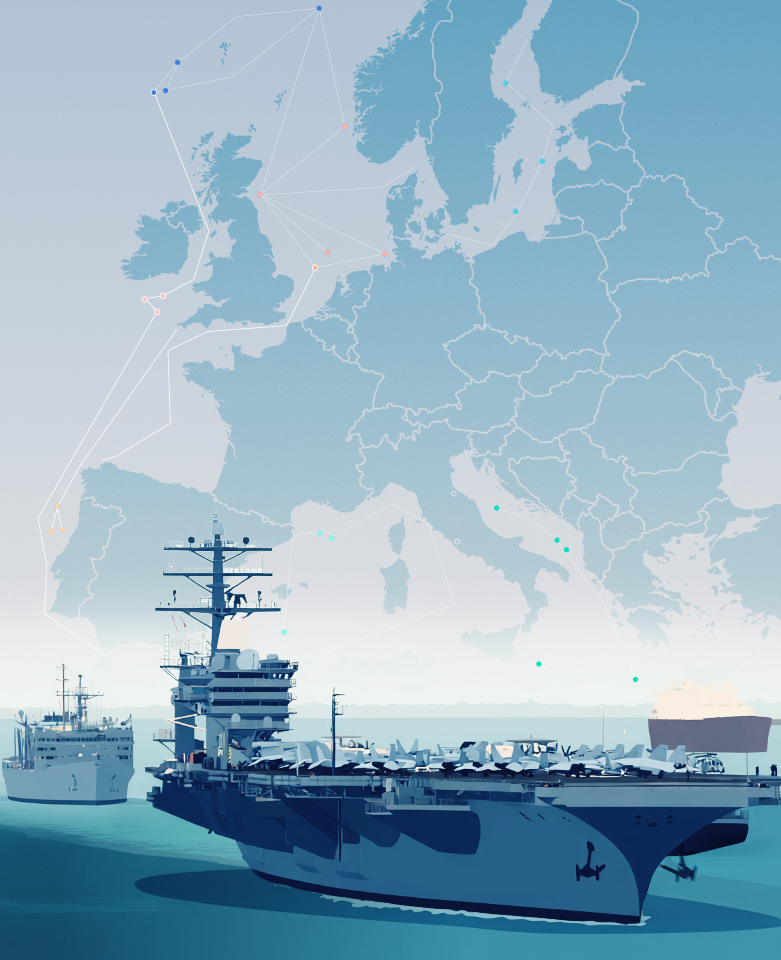
Maintaining accurate and timely awareness of maritime forces is essential for NATO’s ability to plan, coordinate, and execute operations at sea. Maritime commanders must continuously track the availability, location, and tasking of allied naval units across vast operational areas, often while managing multiple missions simultaneously. Achieving this level of situational awareness requires the rapid integration of operational plans, incoming reports, and real-time updates from numerous maritime platforms and national contributors.
To address this operational challenge, Allied Command Transformation (ACT) has delivered the NATO Maritime Availability Database (NMAD), a digital capability designed to improve visibility and coordination across NATO’s maritime domain.
Developed by ACT’s Innovation Branch, NMAD demonstrates how the Norfolk-based strategic command is accelerating the delivery of practical solutions that directly support operational commanders and warfighters.
The NMAD system has now been successfully delivered to MARCOM, central command of all NATO maritime forces, and is fully operational, supporting the effectiveness of NATO maritime operations. This cloud-based web application is accessible to NATO’s maritime operational staff, maritime units, and member nations, providing a shared platform that enhances coordination and information exchange across the Alliance.
Delivering Innovation to the Maritime Domain
Developed through close collaboration with operational users, the NMAD system enables operators to visualise and report on the current and projected positions of maritime units alongside their assigned tasks and capabilities. By integrating operational plans with incoming reports and operational messaging, the platform provides a consolidated view of maritime force availability and activity.
This approach reflects ACT’s user-driven innovation model. Warfighters are embedded directly into the development process, working shoulder-to-shoulder with operators who use these systems daily. Requirements evolve from real operational
feedback, enabling rapid prototyping, iteration, and fielding of mission-critical capabilities in weeks or months, not years. As a result, warfighters receive operationally-ready systems tailored to their missions and decision cycles, allowing them to employ new capabilities at unprecedented speed from day one.
The development of NMAD required detailed technical planning and close cooperation with operational stakeholders to ensure the system met real-world operational needs. It was designed to integrate seamlessly with existing maritime platforms and command-and-control systems, allowing it to function effectively within NATO’s broader digital ecosystem.
Despite a demanding development timeline, the ACT innovation team delivered a fully functional and secure solution capable of meeting operational requirements while remaining adaptable for future enhancements.
Strategic Implications and Next Steps
Maritime operations involve a complex network of ships, submarines, and supporting assets operating across multiple regions and missions. Without a unified system to track their availability, location, and tasking, maintaining a clear operational picture can become increasingly challenging, particularly during high-tempo or multinational operations.
NMAD addresses this challenge by providing commanders and planners with a shared environment where maritime forces availability and operational commitments can be visualised and analysed. By consolidating operational data and reporting into a single platform, the system enhances situational awareness, improves coordination between NATO maritime forces and member nations, and supports faster, more informed decision-making.
The successful delivery of NMAD represents, therefore, an important step in strengthening NATO’s maritime situational awareness and planning capabilities, improving information flow between maritime headquarters and national contributors
while enabling more effective operational coordination across the Alliance.
As the system becomes embedded within NATO’s operational workflows, NMAD will continue to support maritime planning and execution while providing a foundation for future capability development. The platform’s digital architecture also allows for further enhancements and integration with additional maritime data sources and command-and-control systems, ensuring that it can evolve alongside NATO’s operational requirements.
More broadly, the successful fielding of NMAD highlights Allied Command Transformation’s role in rapidly delivering innovative capabilities to the operational community. By working closely with users, ACT can translate operational needs into practical solutions that strengthen NATO’s ability to operate effectively across the maritime domain.